November 2026
To Bacon, or not to Bacon: that is the question!
Lewis Griffiths
To Bacon, or not to Bacon: that is the question!
This is the first of three articles which will discuss topical issues connected to modern food production. The manufacture of processed and ultra processed foods is situated some distance from the farm gate at which, traditionally, many veterinary responsibilities end. However, these are debatable subjects, which appear regularly in today's media and which will often benefit from the application of a little science. And the role of veterinarians, as well informed advocates for good science, is an ongoing responsibility.
Veterinarians generally enjoy engaging in conversation! Whether they are working or merely trying to relax with friends, their background as science trained professionals and experienced communicators, often leads to challenging questions during lively debates. And because vets are frequently viewed as advocates for science and medicine by many of their peers and acquaintances, they are expected to know their stuff!
At VetSalus we have long recognised this potentially influential role and much of our work has involved delivering quality, evidence based information which can assist veterinarians as they discuss topics, especially those linked to One Health and sustainability. Thus, when I recently found myself seated around the dinner table with a group of friends, I was not particularly surprised to be asked for an opinion about the consumption of bacon, an opinion I would have probably volunteered anyway! It transpired that several of my fellow diners had recently vowed never to eat bacon again; my initial response was a simple and genuinely curious question “Why?” But because bacon consumption soon becomes a complicated issue it provides an interesting example of veterinary, science based advocacy in action!
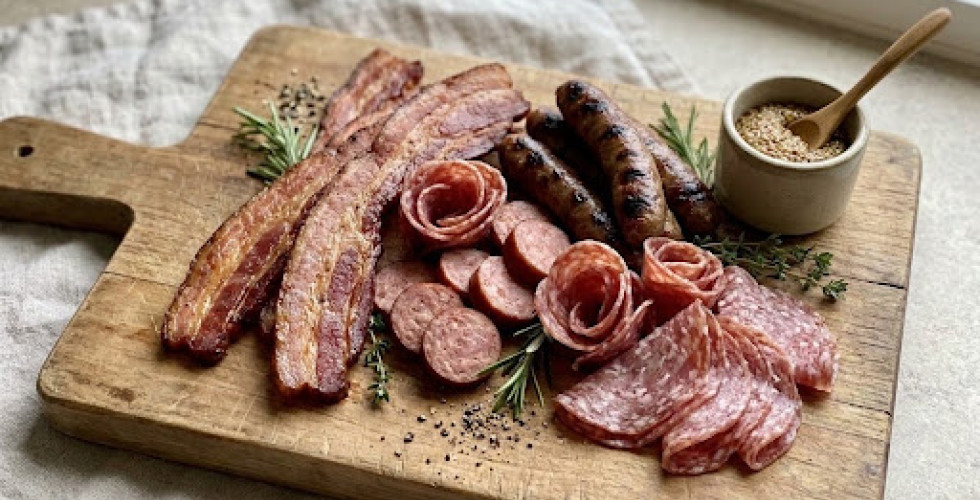
A number of reasons were offered in justification for moving away from this ancient and delicious variant of porcine meat. The list of reasons proffered for not consuming bacon included:
Animal welfare concerns
Antibiotic and drug residues
Sustainability and reducing greenhouse gas emissions
Ultra processed food
Nitrate consumption
Reducing red meat consumption
Reducing animal fat intake
Interestingly there were no vegetarians or vegans around this particular table, so the outright rejection of meat consumption on moral grounds, which is everyone’s fundamental right, did not complicate the conversation at all. However, the world’s pig population of around one billion animals, half of which reside in China, are an important source of protein in many poorer countries[1], whose occupants will frequently be glad to consume whatever is available, without undue analysis of its origins. Also pigs have been farmed by humans since neolithic times, so our consumption of this species is not a recent phenomenon and the long term consumption of pork has not decimated the human population!
Animal welfare concerns have been prominent in discussions about the pig husbandry for many years, with sow stalls and farrowing crates attracting considerable attention. Worldwide, however, there are few species that are farmed in such a range of conditions as pigs and the majority, including a growing population in European countries, enjoy ‘free range’ conditions. So if the animals are raised in a high welfare environment, which might include ‘outdoor reared’ or ‘outdoor bred’ options, eating the resulting bacon will surely not be objectionable? Pork, and pork products, are generally listed as being among the most sustainable of meats when greenhouse gas emissions are examined, but it is always important to compare ‘apples with apples’ and to base these sustainability league tables on extensive Life Cycle Analysis, comparing the relative protein qualities.
Most vets are well aware as to how closely controlled antibiotics and other medicines are in many jurisdictions and at VetSalus we have been working for a number of years to assist in the reduced use of these products. (See our website for examples.[2]) The same is not true of all meat products worldwide. While the EU (and New Zealand) has for many years banned the use of beta-agonists, like ractoamine, a feed additive which can enhance meat leanness, the use of these is still permitted in USA and Canada.
There is very little room for debate around the need for a reduction of red meat consumption, particularly in the western world. A recent article on the Planetary Health Diet by the Lancet[3], which we reviewed[4] on our VetSalus website, provides further evidence that many people consume too much meat, particularly red meat. Traditionally, pork has been cured using brine and other salts including saltpetre (potassium nitrate), in order to preserve it and prevent bacterial decomposition. But it can also be argued that with modern refrigeration there’s no need to preserve pork by pickling it in a chemical soup. There is thus no need to eat bacon but well cured bacon does taste good!
There is currently also a loud debate about ultra-processed foods which can be defined as:
“industrial formulations typically with 5 or more and usually many ingredients.”[5]
It is argued, with increasing evidence, that regular consumption of these ultra-processed food ‘cocktails’ can lead to increased obesity and other medical issues. But by the usual definition bacon, along with sausages and salamis, are classified simply as ‘processed foods’ and in a review article in the Lancet[6] in 2015 it is noted that:
‘meat processing, such as curing and smoking, can result in formation of carcinogenic chemicals’
A detailed reading of this paper indicates a probable association, not a strong proven causative relationship. In the case of preserved meats, positive associations were present in 12 of the 18 cohort studies examined, i.e. one third showed no such association and two recent studies have shown no red meat link.[7] The paper also recognises that many valuable nutrients are contained in red meats.
The much cited link to nitrates is interesting as nitrates are present in many green foods and vegetables, including vegan ‘meats’. Many veterinarians will have encountered nitrate poisoning in stock which are fed winter feeds, such as kale, and will advise their clients that it is the rate of conversion to nitrites, inside the body, and the total dose received that are the critical factors. A few extra rashers of bacon are unlikely to significantly increase the average individual’s daily ingestion of nitrates and potential nitrite poisoning is no basis for the potential rejection of bacon.
However, it is the cooking of bacon at high temperatures that is at the core of the bacon issue. This can lead to the formation of nitrosamines, when nitrates combine with amino acids and this is where the potential for harm really lies; nitrosamines are classed as carcinogens. However, this chemistry can happen whenever proteins and nitrates are cooked at high temperatures, including poultry and plant proteins: it is not bacon specific.
So it’s not the nitrates it’s the nitrosamines and the bacon situation is complex as we are dealing with probabilities not confirmed relationships; these are correlations not causations and other factors are very relevant.
The UK’s NHS offers dietary health advice that states that eating preserved meat probably increases your chance of developing colo-rectal cancer and that intakes should be limited to 70 grams a day - about two average rashers of bacon. This source suggests ingesting it with a rich source of vitamin C and also avocados, will provide some protection - so eat BLAT’s and don’t burn your bacon! But the situation is complicated by other factors: other dietary components, alcohol intake, smoking, obesity and exercise are all very relevant.
The pros and cons of our debate continued through the evening and the wealth of readily availability quality scientific evidence greatly illuminated the discussion. Finally we all agreed that in future we would eat no more than 70 grams of non U.S, high welfare, bacon a day with avocado, and we toasted our resolution by downing several glasses of an excellent, but carcinogenic, Cabernet Sauvignon!
References
[2] (https://vetsalus.com/news/2024/vetsalus-scandinavia-involved-in-amu-think-tank-project)
[3] (https://www.thelancet.com/journals/lancet/article/PIIS0140-6736(25)01201-2/abstract)
[4] (https://vetsalus.com/news/2025/a-revised-vision-for-the-planetary-health-diet-from-the-lancet)
[5] (https://pmc.ncbi.nlm.nih.gov/articles/PMC6389637/#:~:text=These)
[6] (https://www.thelancet.com/journals/lanonc/article/PIIS1470-2045(15)00444-1/fulltext)
[7] (https://journals.plos.org/plosone/article?id=10.1371/journal.pone.0020456)